Reviews are disappearing faster than ever as moderation systems, industry risk, and geography increasingly determine which reviews remain visible.
Over the past year, Google is deleting reviews at unprecedented levels — and this shift is very much intentional.
As online reviews continue to influence customer trust, local visibility, and purchasing decisions, the large-scale removal of reviews presents new challenges for hotels, restaurants, and service-based businesses alike.
Why Google Is Deleting Reviews More Aggressively
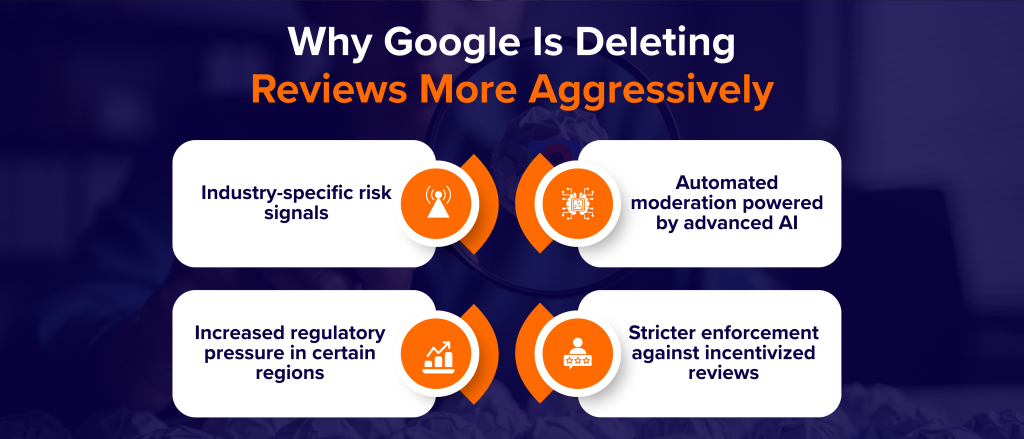
Multiple forces are driving the sharp rise in review removals, including:
- Automated moderation powered by advanced AI
- Industry-specific risk signals
- Stricter enforcement against incentivized reviews
- Increased regulatory pressure in certain regions
Together, these factors are reshaping how reviews are evaluated, filtered, and removed — often without warning to the business.
Review Deletions Are Increasing Worldwide

Data collected across tens of thousands of business listings shows a clear global trend: review deletions are accelerating.
The increase began building momentum in early 2025 and intensified mid-year, with more locations experiencing at least one deleted review in any given week. This trend affects businesses of all sizes and is not limited to a single region.
Importantly, this surge is not confined to recent reviews alone. Older reviews are also being removed as moderation systems reassess historical content. This suggests a shift from reactive moderation toward more continuous, system-wide enforcement.
Early indicators suggest this enforcement trend has continued into 2026, reinforcing that elevated review volatility is no longer a temporary adjustment but an ongoing reality for businesses managing their online reputation.
As moderation systems evolve, both negative and positive reviews are subject to increased scrutiny — making active monitoring and structured response strategies more critical than ever.
Positive Reviews Are No Longer Safe
While negative feedback has always been subject to removal, five-star reviews now represent a growing share of deleted content.
This pattern suggests stronger enforcement aimed at detecting:
- Incentivized feedback
- Coordinated review activity
- Reviewer behavior that appears unnatural
Even well-intentioned positive reviews may be flagged if they resemble spam or violate evolving authenticity standards. As a result, businesses can no longer assume positive sentiment guarantees visibility.
Learn more about best practices for responding to customer reviews to maintain credibility and trust.
Industry Risk Plays a Major Role
Not all industries experience review deletions equally.
High-volume categories such as restaurants, home services, and retail tend to see the highest number of removals. These sectors generate large amounts of feedback, increasing exposure to automated enforcement across both recent and older reviews.
More regulated or trust-sensitive industries often show fewer overall deletions, but closer analysis reveals consistent patterns shaped by perceived risk rather than manual intervention.
This indicates ongoing enforcement — not isolated cleanup efforts.
Review Ratings Reveal Moderation Patterns
According to analyses published by industry researchers and search marketing publications, examining deleted reviews by rating reveals clear moderation patterns.
In some industries, removals appear relatively balanced across one- to five-star reviews. In others, five-star reviews have been disproportionately affected — particularly in categories where trust, safety, or compliance risks are higher.
Those who have examined large-scale deletion data suggest that moderation systems may dynamically adjust scrutiny levels based on industry risk signals, historical abuse patterns, and behavioral anomalies, rather than applying static or uniform enforcement rules.
While businesses do not have visibility into Google’s internal moderation algorithms, the observable patterns indicate that enforcement is both automated and context-sensitive.
Timing Matters for Review Removals
The age of a review plays a significant role in when it is removed.
In higher-risk categories, many reviews disappear within the first few months after posting. This points to early intervention by automated systems evaluating language, reviewer history, and behavioral signals.
Other industries show a different pattern, with removals occurring years later. These retroactive deletions often result from improved detection methods or newly identified suspicious patterns.
For businesses, this means reviews can vanish long after being published — often without notification.
Geography Influences Review Enforcement
Location adds another layer of complexity to review visibility.
Published analyses suggest that moderation patterns can vary across markets due to differences in regulatory environments, abuse trends, and reporting behavior. In many English-speaking markets, removal activity has included a significant share of positive reviews, consistent with broader efforts to reduce spam, incentivized content, and coordinated review manipulation.
In other regions, legal frameworks related to defamation, consumer protection, and digital platform accountability may influence how quickly disputed content is reviewed or escalated. However, enforcement actions are not limited to negative reviews. In many jurisdictions, regulatory scrutiny has focused heavily on businesses generating fake positive reviews or misleading testimonials.
Rather than favoring one rating level over another, moderation appears increasingly driven by signals of authenticity, behavioral anomalies, and policy violations.
Understanding both industry risk profiles and regional regulatory environments is essential when interpreting review volatility.
What This Means For Local SEO Performance
The rise in review deletions creates two major challenges:
Trust Erosion
When legitimate reviews disappear without explanation, customer confidence in review platforms weakens.
Data Distortion
Deleted reviews affect star ratings, benchmarks, and conversion signals that businesses rely on for local SEO performance.
For businesses and multi-location brands, consistent review monitoring strategies are now critical to maintaining visibility and accuracy.
The Reputation Lab Approach to Review Monitoring
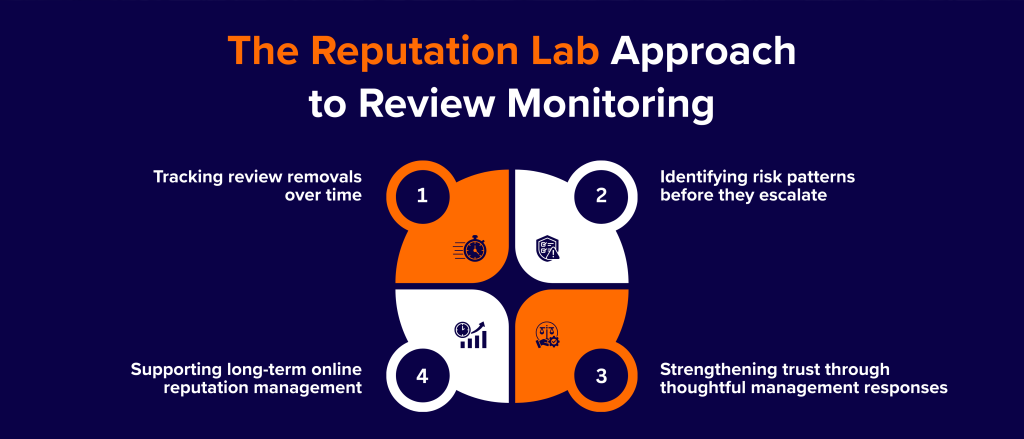
At The Reputation Lab, we help businesses stay ahead of review volatility through continuous monitoring, detailed reporting, and best-practice response strategies.
Our approach focuses on:
- Tracking review removals over time
- Identifying risk patterns before they escalate
- Strengthening trust through thoughtful management responses
- Supporting long-term online reputation management
As review moderation becomes more automated and legally influenced, success depends not just on collecting reviews — but on understanding which ones remain visible and why.