
Hotel discovery is changing — and fast.
The latest travel search trends show a clear shift away from simple keyword-based discovery toward intent-driven exploration shaped by AI, visuals, and trust signals. Travelers are no longer following a straight path from search to booking. Instead, they explore broadly, refine gradually, and commit only when confidence is established.
For hotels, this means visibility now depends less on ranking for generic terms and more on how clearly a property communicates guest experience, credibility, and intent across the entire discovery journey.
How Travel Search Trends Are Shifting Toward Intent
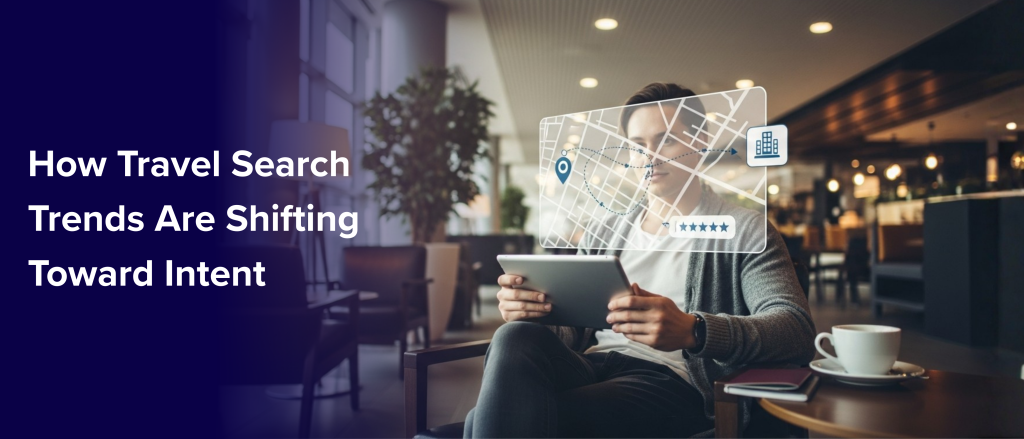
Today’s travel search journey is no longer linear or purely keyword-driven. Travelers move fluidly between inspiration, exploration, validation, and booking — often across multiple platforms and devices.
What’s changed most is how early-stage intent is formed.
Travelers increasingly begin with open-ended, conversational exploration. Instead of searching “best boutique hotel in Barcelona,” they may start with broader prompts like:
- “Where should I stay in Barcelona for a romantic anniversary?”
- “Best areas in Barcelona for food and nightlife?”
- “Quiet beach destinations in Spain in September?”
These queries reflect intent before destination or brand preference is defined. At this stage, the traveler is clarifying needs, mood, budget, and experience expectations — not selecting a specific property.
As intent becomes clearer, the journey naturally begins to divide.
Guest Journeys Now Split Between Exploration and Booking
Many travelers start planning with inspiration rather than a specific hotel in mind. Early-stage discovery focuses on destinations, experiences, and travel styles.
As plans solidify, behavior shifts. Travelers return to traditional search to validate options, compare properties, and book directly. Queries become more specific, brand-focused, and transactional.
This split journey creates two critical visibility moments:
- Exploratory discovery
- Decision-stage confirmation
Performance at the booking stage increasingly depends on the trust signals accumulated earlier in the journey.
This evolution in journey structure is also reshaping how search terms behave.
Generic Hotel Keywords Are Losing Influence

One of the clearest travel search trends is the declining influence of broad hotel keywords.
Search behavior increasingly favors specific property names and well-defined queries. This signals that travelers are arriving at search engines more informed, having narrowed their choices through prior exploration.
For hotels, this means ranking for generic terms matters less than ensuring that when a traveler searches for your property, the experience they find reinforces confidence and credibility.
Visibility is no longer just about appearing — it’s about validating intent.
Images Are Now a Form of Searchable Intelligence
As discovery evolves, so do the signals that influence visibility.
Visual content has taken on a new strategic role in hotel discovery. AI-driven search tools can now interpret images and videos to identify amenities, features, and experiences — even when those details are not explicitly described in text.
Pools, views, room layouts, workspace setups, and dining environments all contribute to discoverability.
But visuals work most effectively when reinforced by guest feedback. Images create expectations; reviews confirm them.
Reviews Shape How AI Understands Experience

Guest reviews have become one of the most influential signals in modern travel search.
Beyond ratings, reviews help interpret emotional and experiential qualities that structured data cannot fully capture. Descriptors such as “quiet,” “romantic,” “family–friendly,” or “ideal for business travel” typically emerge from unstructured guest language.
These patterns help AI-driven systems understand not just what a hotel offers, but who it is best suited for — making reviews essential for both discovery and conversion.
Consistent review monitoring ensures this narrative remains accurate, relevant, and aligned with guest expectations.
Discovery Is Becoming More Exploratory
A meaningful share of travel searches each year are entirely new. This reflects how travelers use AI-assisted exploration to move from vague inspiration toward clearer booking intent.
Rather than searching for predefined terms, travelers test ideas, compare scenarios, and refine preferences along the way.
Hotels that clearly communicate experience — through visuals, reviews, and thoughtful responses — are more likely to surface during these exploratory moments.
Reputation, in this context, becomes an active driver of discovery rather than a passive reflection of performance.
Progress Matters More Than Perfection
One of the most important lessons from evolving travel search trends is that waiting for certainty is a risk.
Search behavior, AI capabilities, and discovery patterns will continue to evolve. Hotels that act now — improving review quality, visual consistency, and response practices — gain an advantage over those waiting for a definitive playbook.
Incremental improvements compound over time, strengthening both visibility and trust.
The Reputation Lab Perspective
At The Reputation Lab, we help hotels align with modern travel search trends by focusing on what matters most: trust, intent, and clarity.
Through review monitoring, reporting, and thoughtful response strategies, we help properties remain legible to both travelers and search systems at every stage of the journey.
As discovery becomes more exploratory and intent-driven, reviews are no longer just feedback — they are a core visibility asset.